

In the cutthroat world of high-frequency trading DApps, where sub-second latencies separate profit from peril, generic rollups buckle under the strain of indiscriminate mempools and egalitarian fee schedules. Custom app-chains with priority fee auctions redefine this landscape, handing traders the reins to bid aggressively for blockspace supremacy. Picture market makers on Etherlink, now boasting sub-50ms confirmations that slash spreads and turbocharge reactions to volatility spikes. This isn't mere optimization; it's a macroeconomic recalibration, channeling rollup fee markets trading toward those who value speed most.
Such architectures sidestep the pitfalls of public mempools, where richest bidders dominate via Priority Gas Auctions (PGAs), as seen across Solana's Jito integrations or Sui's gas-based conflict resolution. For HFT, this sovereignty means crafting specialized fee structures HFT dApps that prioritize throughput over decentralization dogma. Aevo's OP-Stack rollup, clocking 5,000 TPS with off-chain matching, exemplifies how application-specific blockchains trading custody assets on-chain while unleashing off-chain velocity.
The Strategic Edge of Sovereign Sequencing
Devs migrating to app-chains like dYdX witness 100x throughput leaps because they command the full stack: execution, sequencing, data availability. No longer beholden to Ethereum's base fee whims or L2 solver wars eroding margins via ERC-7683 bridge auctions, builders engineer dynamic fees custom rollups attuned to HFT rhythms. Arbitrum's TimeBoost, funneling $1M monthly in MEV revenue through bidder-driven ordering, proves auctions aren't zero-sum; they redistribute value to protocols fueling the ecosystem.
Contrast this with mempool fee auctions favoring the fastest bots, as Sei Network critiques. Custom app-chains invert the dynamic, letting protocols like Unichain's Superchain L2 impose ultra-fast blocks and priority ordering. Market makers thrive, tightening spreads amid congestion, while retail enjoys predictable costs. This big-picture shift mirrors traditional finance's dark pool evolution, but decentralized: order flow auctions aggregate batches for third-party settlement, per L2IV insights, minimizing toxic MEV.
Engineering Priority Fee Auctions for Latency Domination
At core, priority fee auctions let users tip higher for sequencer favoritism, echoing EIP-1559's demand-responsive base fees but hyper-tuned for HFT. Implement as sealed-bid or first-price auctions to curb collusion, ensuring specialized fee structures HFT dApps allocate slots meritocratically. Raiku's edge compute on Solana, bolstered by Jito's open markets, hints at hybrids where PGAs resolve shared-object tussles instantaneously.
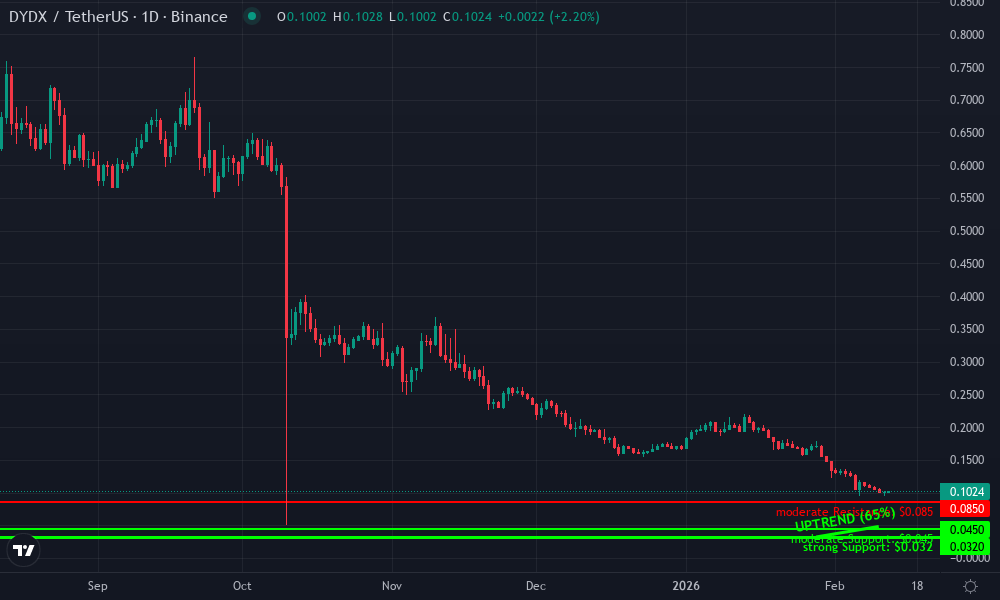
dYdX Technical Analysis Chart
Analysis by Market Analyst | Symbol: BINANCE:DYDXUSDT | Interval: 1D | Drawings: 6
Technical Analysis Summary
As a balanced technical analyst with 5 years experience, annotate this DYDXUSDT chart as follows: 1. Draw a prominent downtrend line (red, thick) from the October 2026 peak at approximately 0.95 (2026-10-15) to the December 2026 low at 0.05 (2026-12-20), highlighting the dominant bearish channel post-hype dump. 2. Add horizontal support line (green, strong) at 0.032, marking the multi-month bottom where price has held multiple times. 3. Place horizontal resistance (orange, moderate) at 0.085, previous swing low now overhead. 4. Rectangle range for Jan-Feb 2026 consolidation between 0.032-0.055. 5. Arrow down marker on the sharp Nov-Dec dump candle. 6. Callout on volume spike during breakdown noting 'capitulation volume'. 7. Text label near recent candles: 'Oversold consolidation amid app-chain positive news'. 8. Fib retracement from peak to bottom, noting 61.8% at ~0.45 unlikely soon. 9. Long position marker near 0.035 entry. Use balanced colors: red for bearish, green for bullish potentials.
Risk Assessment: medium
Analysis: Extreme volatility post-dump but oversold signals and positive dYdX ecosystem news (app-chain, HFT optimizations) balance the bearish structure; medium tolerance suits scaled entries
Market Analyst's Recommendation: Long bias from support with 1-2% risk per trade, target 0.08-0.10; monitor for volume pickup
Key Support & Resistance Levels
📈 Support Levels:
- $0.032 - Strong multi-touch bottom since Dec 2026, volume shelf strong
- $0.045 - Intermediate support from Jan swing low moderate
📉 Resistance Levels:
- $0.085 - Dec swing low turned resistance, prior accumulation high moderate
- $0.12 - Psychological and Nov breakdown level weak
Trading Zones (medium risk tolerance)
🎯 Entry Zones:
- $0.035 - Bounce from strong support in low-volume regime, aligns with app-chain catalysts medium risk
- $0.042 - Break above consolidation midpoint for confirmation low risk
🚪 Exit Zones:
- $0.085 - First resistance target, 2.5:1 RR 💰 profit target
- $0.1 - Measured move extension 💰 profit target
- $0.028 - Below key support invalidation 🛡️ stop loss
Technical Indicators Analysis
📊 Volume Analysis:
Pattern: capitulation spike then dry-up
Massive red volume bars on Nov-Dec dump indicate exhaustion, now low volume basing suggests accumulation
📈 MACD Analysis:
Signal: bearish divergence flattening
MACD line deep negative but histogram contracting with price lows higher, bullish divergence hint
Applied TradingView Drawing Utilities
This chart analysis utilizes the following professional drawing tools:
Disclaimer: This technical analysis by Market Analyst is for educational purposes only and should not be considered as financial advice. Trading involves risk, and you should always do your own research before making investment decisions. Past performance does not guarantee future results. The analysis reflects the author's personal methodology and risk tolerance (medium).
Opinion: Forget based rollups' sequencer reliance; sovereign app-chains with auctions empower devs to auction not just inclusion, but precise positioning. Delphi's Sui deep-dive reveals gas PGAs nipping frontrunning, yet custom chains amplify this via app-specific ordering, per Sei's MEV redistribution manifesto. Builders must calibrate auction cadences to block times, say 100ms intervals, mirroring Etherlink's 10x speed-up for DeFi traders.
Navigating MEV and Congestion in Fee Market Design
MEV looms as HFT's shadow, with Cryptechie's estimates pegging its scale in billions via frontrunning bids. Custom app-chains neutralize this through private mempools or encrypted auctions, evolving public PGAs into solver competitions that reward efficiency over brute gas wars. Unichain's priority mechanisms mitigate latency arbitrage, funneling MEV back to users rather than extractors.
Strategically, integrate dynamic adjustments: fees surge in volatility, subsidizing low-congestion idle times. This mirrors dynamic fee markets powering scalable app-chains, balancing utilization without stifling adoption. For HFT DApps, reliability trumps raw speed; vet infrastructures like Optimism stacks for outage resilience, ensuring market makers dodge the downtime dragons plaguing generalists.
Yet true mastery lies in hybrid designs that layer private mempools atop public auctions, shielding HFT orders from predatory bots while preserving open competition. Order flow auctions, as dissected by L2IV Research, batch user transactions for solver execution, slashing rollup fee markets trading costs and redistributing alpha to protocols. This isn't charity; it's shrewd economics, converting MEV drag into protocol fuel.
Calibrating Auctions for Peak HFT Performance
Sealed-bid auctions emerge as the gold standard for custom app-chains priority fee auctions, masking bids to deter gaming while guaranteeing fair slot allocation. Tune parameters ruthlessly: set reserve prices to floor toxic bids, escalate increments during flash crashes, and decay fees post-volatility to lure volume back. Aevo's derivatives-focused rollup nails this, blending 5,000 TPS off-chain matching with on-chain safeguards, proving application-specific blockchains trading needn't sacrifice security for speed.
Opinion: Generalist L2s like Optimism stacks falter here, their solver fee wars bleeding billions in bridge inefficiencies per ERC-7683 breakdowns. Custom chains flip the script, auctioning not just priority but sequencing rights, echoing Sei's application-specific ordering that neuters richest-first mempools. Builders eyeing HFT should benchmark against Etherlink's instant confirmations, where market makers shave spreads by reacting in sub-50ms bursts, a macro edge amplifying across DeFi liquidity pools.
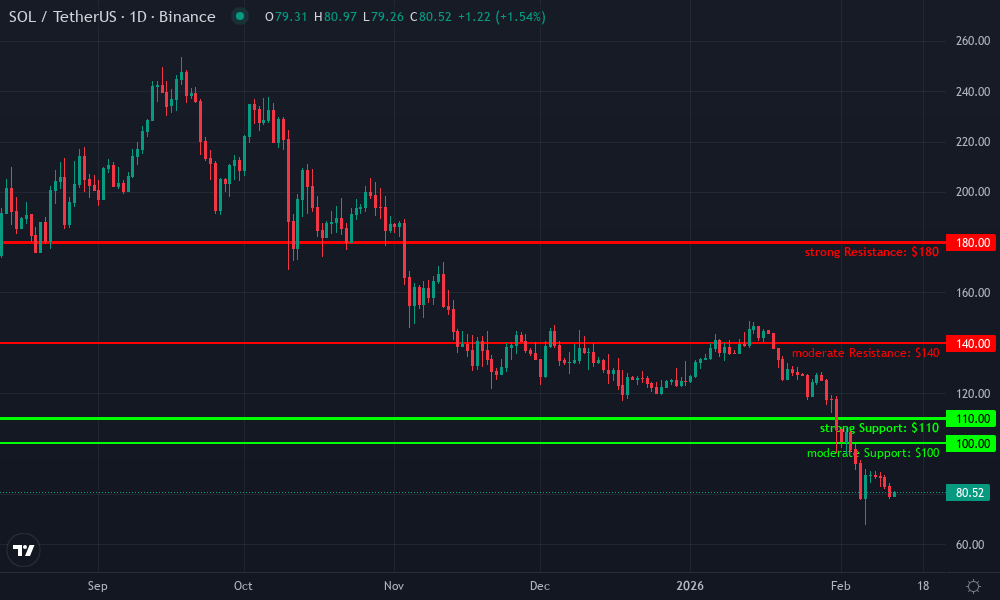
Solana Technical Analysis Chart
Analysis by Market Analyst | Symbol: BINANCE:SOLUSDT | Interval: 1D | Drawings: 7
Technical Analysis Summary
In my balanced technical style, start by drawing a primary downtrend line connecting the October 2026 high near 240 to the late December 2026 low around 115, using 'trend_line' tool. Add horizontal lines at key support 110 and resistance 180, 140. Apply fib retracement from the major low at 110 up to 240 high for potential retracement levels. Mark the recent consolidation rectangle from mid-December to now between 110-130. Use arrow_mark_down at MACD bearish crossover in November, and callout on volume spike during the rebound. Vertical line at the breakdown below 140 in early December. Long position marker near 112 entry if bounces.
Risk Assessment: medium
Analysis: Clear structure with defined levels reduces uncertainty, but crypto volatility and downtrend warrant caution
Market Analyst's Recommendation: Consider long entries on support confirmation with tight stops, aligning with medium risk tolerance; avoid aggressive shorts near lows
Key Support & Resistance Levels
📈 Support Levels:
- $110 - Cluster of recent lows and round number strong
- $100 - Psychological support and channel lower bound moderate
📉 Resistance Levels:
- $140 - Prior swing high and fib 50% retracement moderate
- $180 - November rebound high strong
- $240 - Major October high strong
Trading Zones (medium risk tolerance)
🎯 Entry Zones:
- $112 - Potential bounce from strong support with volume confirmation medium risk
🚪 Exit Zones:
- $140 - Initial resistance test at prior high 💰 profit target
- $140 - Strong overhead supply zone 💰 profit target
- $105 - Invalidation below key support 🛡️ stop loss
Technical Indicators Analysis
📊 Volume Analysis:
Pattern: Declining volume on downside, spike on December rebound
Bearish price action on low volume indicates weak selling pressure
📈 MACD Analysis:
Signal: Bearish crossover in November with ongoing histogram contraction
Momentum fading, potential for bullish divergence if price holds support
Applied TradingView Drawing Utilities
This chart analysis utilizes the following professional drawing tools:
Disclaimer: This technical analysis by Market Analyst is for educational purposes only and should not be considered as financial advice. Trading involves risk, and you should always do your own research before making investment decisions. Past performance does not guarantee future results. The analysis reflects the author's personal methodology and risk tolerance (medium).
Dynamic calibration extends to oracle integrations, piping real-time volatility into fee algorithms for proactive surges. Raiku's Solana edge layer demonstrates this hybrid vigor, marrying Jito's MEV client with priority fees to resolve compute races without gridlock. For HFT DApps, this means not just surviving congestion but weaponizing it, turning rivals' bids into your tailwind.
Deployment Blueprint: From Concept to Live Trading
Launching demands precision. Start with sovereign rollup frameworks like OP Stack or Cosmos SDK, grafting auction logic into sequencers via smart contracts. Test under simulated flash crashes, scaling to 10,000 TPS while monitoring bid collusion via game-theoretic audits. Unichain's Superchain playbook offers a template: ultra-fast blocks paired with priority ordering, slashing latency arbitrage and funneling MEV to stakers.
Post-launch, govern iteratively. Delegate fee parameter tweaks to DAOs attuned to trader sentiment, ensuring specialized fee structures HFT dApps evolve with market regimes. Delphi's Sui analysis underscores gas PGAs' role in object contention, a lesson for app-chains: prioritize conflict resolution at the execution layer to preempt auction overloads. Reliability reigns; chainscorelabs data on dYdX's 100x throughput leap affirms that outage-proof infra underpins sustained HFT dominance.
Zoom out, and dynamic fees custom rollups herald a seismic shift. No longer do HFT desks cede ground to centralized exchanges; app-chains democratize dark pool potency, batching flows transparently while auctioning edges meritocratically. As Cryptechie quantifies MEV's billions-scale bounty, protocols capturing it via auctions don't just thrive, they redefine capital efficiency in crypto's next cycle. Traders bidding for supremacy today forge tomorrow's liquidity empires, one prioritized block at a time.




No comments yet. Be the first to share your thoughts!