
In the competitive arena of blockchain applications, custom app-chains stand out by allowing developers to craft tailored fee markets that align perfectly with specific use cases. However, the persistent hurdle of gas fees often deters mainstream adoption, especially for NFT minting where users expect seamless, frictionless interactions. ERC-4337 paymasters address this head-on by sponsoring transaction costs, paving the way for gasless experiences. Integrating them into custom app-chains not only enhances UX but also optimizes fee abstraction in rollups, making gasless NFT minting rollups a reality without compromising security or decentralization.
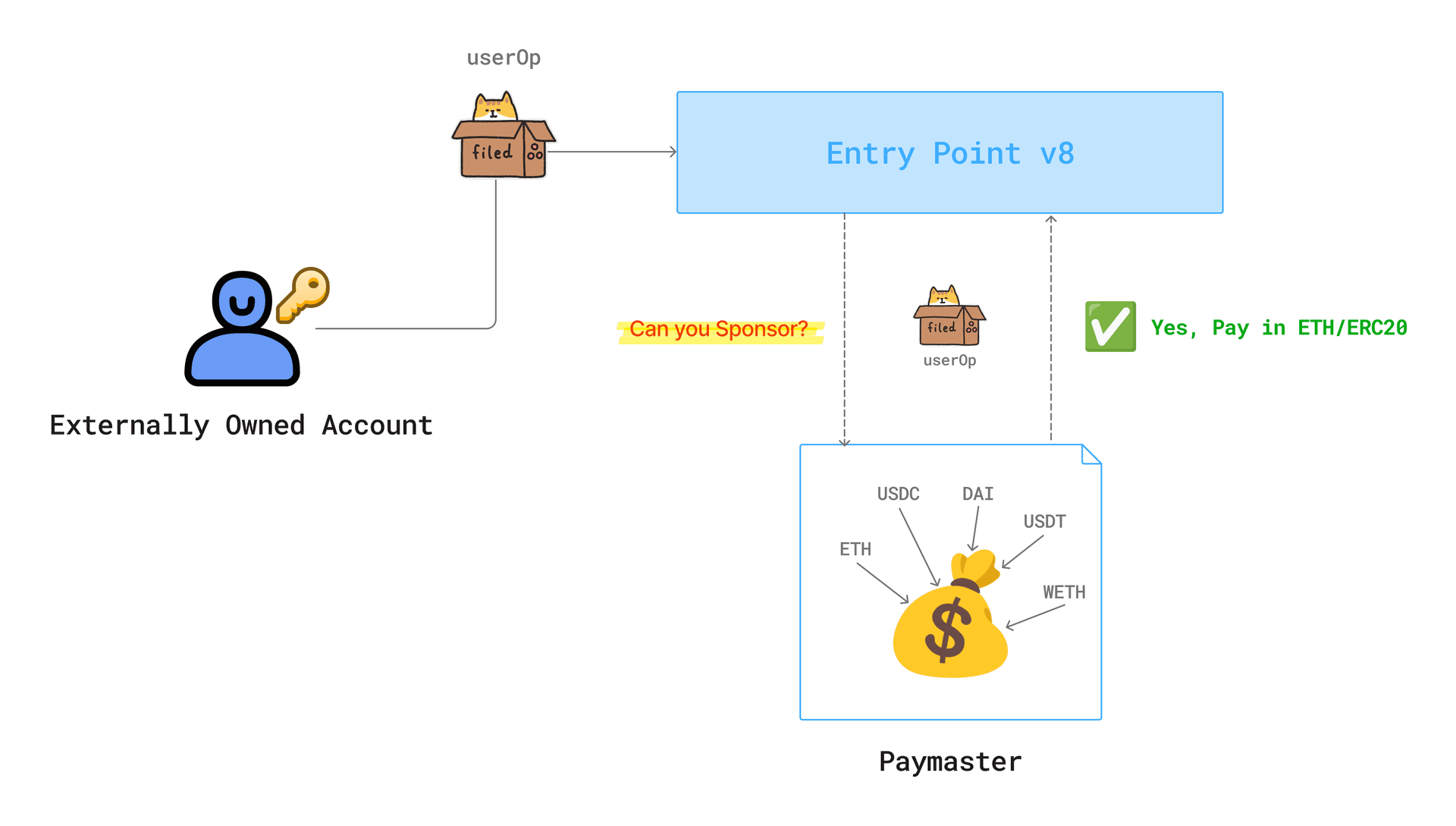
At their core, ERC-4337 paymasters are smart contracts that validate and fund UserOperations submitted to the EntryPoint contract. During the validation phase, a paymaster assesses the operation's legitimacy; if it passes, the paymaster covers the required gas costs from its own deposit. This mechanism relies on staking requirements: paymasters must lock ETH (or equivalent in the chain's native token) to deter malicious behavior, ensuring they have skin in the game. Real-world examples like Etherspot's Arka Paymaster and Circle's USDC-based paymaster illustrate how these contracts enforce rules, from ERC-20 payments to third-party sponsorships, all while maintaining economic incentives.
Why Custom App-Chains Amplify Paymaster Potential
Standard EVM chains impose rigid gas mechanics tied to ETH, but custom app-chains paymasters thrive in environments where fee markets are bespoke. In a custom rollup, developers can redefine gas units to prioritize NFT-related operations, slashing costs for minting while charging premium fees for high-value trades. This app-chain fee optimization transforms paymasters from mere sponsors into strategic tools for ecosystem growth. Consider a gaming app-chain: paymasters could subsidize mints for new players using in-game tokens, bootstrapping virality without native token holdings.
ERC-4337 Paymaster for Gasless NFT Mints
To enable gasless NFT minting on a custom rollup using ERC-4337, deploy a paymaster contract that sponsors UserOperations calling the NFT contract's mint function. This example implements the IPaymaster interface, validating the operation's target and selector while deferring payment to postOp, where the EntryPoint deducts gas costs from the paymaster's balance. Fund the paymaster with ETH beforehand to cover sponsorships.
```solidity
// SPDX-License-Identifier: MIT
pragma solidity ^0.8.19;

import {IPaymaster, PackedUserOperation} from "@account-abstraction/contracts/v0.6/IPaymaster.sol";
import {IEntryPoint} from "@account-abstraction/contracts/v0.6/IEntryPoint.sol";

/// @title NFTMintPaymaster
/// @notice ERC-4337 Paymaster for sponsoring gasless NFT mints on custom rollups
/// @dev Validates UserOperations targeting the NFT contract's mint function
contract NFTMintPaymaster is IPaymaster {

    address public immutable NFT_CONTRACT;
    bytes4 public immutable MINT_SELECTOR;

    error InvalidTarget();
    error InvalidMintSelector();

    constructor(address nftContract, bytes4 mintSelector) {
        NFT_CONTRACT = nftContract;
        MINT_SELECTOR = mintSelector;
    }

    /// @inheritdoc IPaymaster
    function validatePaymasterUserOp(
        PackedUserOperation calldata userOp,
        bytes32 userOpHash,
        uint256 maxCost
    ) external override returns (bytes memory context, uint256 validationData) {
        // Extract target from callData: first 20 bytes
        address target = address(bytes20(userOp.callData[:20]));
        if (target != NFT_CONTRACT) revert InvalidTarget();

        // Extract selector: bytes 20-24
        bytes4 selector = bytes4(userOp.callData[20:24]);
        if (selector != MINT_SELECTOR) revert InvalidMintSelector();

        // Paymaster validation succeeds: provide empty context and validationData=0
        return ("", 0);
    }

    /// @inheritdoc IPaymaster
    function postOp(
        PostOpMode mode,
        bytes calldata context,
        uint256 actualGasCost
    ) external override {
        // EntryPoint will pull required ETH from paymaster for gas costs
        // Ensure paymaster is funded with sufficient ETH
    }
}
```
This paymaster ensures only mint transactions are sponsored, preventing abuse. Customize validation (e.g., add mint limits via context or off-chain tracking) and deploy alongside an ERC-4337 EntryPoint on your app-chain. Wallets must specify this paymaster in UserOperations for gasless mints.
The beauty lies in modularity. ERC-4337's standardized JSON-RPC endpoints and smart account ecosystem port seamlessly to app-chains supporting EVM compatibility. Yet, pitfalls abound: OtterSec highlights risks like validation logic flaws that could drain deposits. In custom setups, rigorous auditing becomes non-negotiable, as tailored fee markets might expose novel attack vectors. My take? Prioritize on-chain verification loops over off-chain oracles for paymaster decisions; the precision outweighs the marginal gas overhead.
Architecting Paymasters for Gasless NFT Minting
To enable gasless NFT minting in custom app-chains, begin with deploying the EntryPoint contract, the linchpin of ERC-4337. Customize its configuration to interface with your chain's sequencer and fee mechanism, ensuring paymasters can post gas payments directly to the bundler. A typical flow: user signs a UserOperation targeting the NFT contract's mint function; the paymaster validates via whitelists or token balances, then pledges gas during bundling.
Implementation demands attention to deposit management. Paymasters maintain a balance via the EntryPoint's deposit functions, replenished by the app-chain's sponsor, perhaps through revenue-sharing from NFT royalties. For abuse prevention, integrate rate limits and signature schemes, allowing dynamic rules like "mint only during drops" or "cap per wallet. " In practice, services like CDP Paymaster on Base demonstrate this on L2s; adapting to sovereign app-chains involves forking and tweaking for native token staking, unlocking true sovereignty in fee abstraction custom rollups.
Validation Strategies Tailored to App-Chain Economics
Paymaster validation is where creativity shines. Beyond basic sponsorship, enforce app-specific economics: require NFT minters to hold a governance token or complete a social proof challenge. This not only curbs spam but aligns incentives with the chain's tokenomics. Data from ERC-4337 docs underscores batched calls for efficiency, ideal for multi-mint sessions in NFT collections. In my analysis, chains ignoring these nuances risk subsidizing bots over genuine users, eroding paymaster viability.
Advanced paymasters can even integrate with oracles for dynamic pricing, adjusting sponsorship based on NFT floor prices or network congestion, a boon for volatile gasless NFT minting rollups. This level of tailoring exemplifies why custom app-chains paymasters outpace generic L2 solutions: they embed fee logic directly into the chain's DNA, fostering sustainable economics.
Hands-On: Deploying a Paymaster Contract
Let's dissect a simplified paymaster implementation, focusing on validation for NFT mints. The contract inherits from the ERC-4337 base, overriding the validatePaymasterUserOp function to check user eligibility before committing funds. Key: whitelist the NFT contract address and enforce a mint cap per user via a mapping. This setup ensures only targeted operations drain the deposit, preserving funds for genuine activity.
Basic ERC-4337 Paymaster with NFT Mint Validation, Whitelisting, and Rate Limiting
This section presents a foundational ERC-4337 Paymaster contract tailored for sponsoring gasless NFT mints on a custom app-chain. It enforces precise validation by decoding the UserOperation's callData to confirm execution of the NFT contract's `mint(address)` function via the standard `execute` method. Whitelisting restricts sponsorship to approved smart accounts, while rate limiting caps mints per account at 5 to mitigate abuse.
```solidity
// SPDX-License-Identifier: MIT
pragma solidity ^0.8.19;

import {IPaymaster, PackedUserOperation} from "@account-abstraction/contracts/v0.7/IPaymaster.sol";
import {IEntryPoint} from "@account-abstraction/contracts/v0.7/IEntryPoint.sol";

interface INFT {
    function mint(address to) external;
}

contract BasicNFTMintPaymaster is IPaymaster {
    IEntryPoint public immutable entryPoint;

    address public nftContract;
    uint256 public constant MAX_MINTS_PER_USER = 5;

    mapping(address => uint256) public mintCount;
    mapping(address => bool) public whitelisted;

    address public owner;

    bytes4 private constant EXECUTE_SELECTOR = 0xf0a3eefa; // keccak256("execute(address,uint256,bytes)")
    bytes4 private constant MINT_SELECTOR = INFT.mint.selector;

    event AccountWhitelisted(address indexed account);
    event MintCountUpdated(address indexed account, uint256 newCount);

    constructor(IEntryPoint _entryPoint, address _nftContract) {
        entryPoint = _entryPoint;
        nftContract = _nftContract;
        owner = msg.sender;
    }

    modifier onlyOwner() {
        require(msg.sender == owner, "Only owner");
        _;
    }

    /// @notice Add an account to the whitelist for gasless minting
    function addToWhitelist(address account) external onlyOwner {
        whitelisted[account] = true;
        emit AccountWhitelisted(account);
    }

    /// @inheritdoc IPaymaster
    function validatePaymasterUserOp(
        PackedUserOperation calldata userOp,
        bytes32 userOpHash,
        uint256 maxCost
    ) external override returns (bytes memory context, uint256 validationData) {
        require(msg.sender == address(entryPoint), "Only EntryPoint");

        // Decode the UserOp callData assuming standard execute(address dest, uint256 value, bytes func)
        (address dest, uint256 value, bytes memory func) = abi.decode(userOp.callData[4:], (address, uint256, bytes));
        require(value == 0, "Value must be zero");
        require(dest == nftContract, "Target must be NFT contract");
        require(func.length >= 4, "Invalid func data");
        require(bytes4(func) == MINT_SELECTOR, "Must call mint function");

        address sender = userOp.sender;
        require(whitelisted[sender], "Account not whitelisted");
        require(mintCount[sender] < MAX_MINTS_PER_USER, "Rate limit exceeded");

        // Increment rate limit counter
        mintCount[sender]++;
        emit MintCountUpdated(sender, mintCount[sender]);

        // Valid: empty context, validationData 0 (valid until infinity)
        return ("", 0);
    }
}
```
Deploy this Paymaster, initialize it with your EntryPoint and NFT contract addresses, fund its EntryPoint deposit, and whitelist target smart accounts. UserOperations meeting these criteria will have gas sponsored automatically. For production, enhance with time-based rate resets, deeper callData validation, and security audits to handle edge cases like failed executions.
Deploy this on your app-chain post-EntryPoint setup, fund the deposit, and stake via the EntryPoint's addStake. Testing reveals gas savings: a sponsored mint drops from 100k gas (user-paid) to zero upfront, with bundlers handling the backend. In custom environments, tweak gas estimation for your sequencer to avoid underbidding.
Step-by-Step Integration for Gasless Mints
Once integrated, frontend wallets like those from Alchemy or dynamic SDKs simplify UserOp bundling. Users sign off-chain; the dapp relays to a bundler, which queries your paymaster. Success metrics from Base's CDP Paymaster show 90% and conversion lifts for gasless flows, a pattern replicable in sovereign chains.
Risks demand scrutiny. Subtle bugs, as OtterSec notes, lurk in paymaster logic: reentrancy during validation or mishandled paymasterAndData can lead to deposit theft. Custom app-chains exacerbate this if sequencers delay finality, stranding funds. Mitigation? Formal verification tools and multi-sig deposits. Staking enforces honesty, but scale it proportionally to expected volume; under-staked paymasters halt operations mid-drop.
Common Pitfalls and Fixes for ERC-4337 Paymasters in App-Chains
| Pitfall | Description | Recommended Fix |
|---|---|---|
| ⚠️ Staking Proportionality | Paymasters must stake ETH proportional to sponsored gas volume; insufficient stake causes UserOperation rejections by EntryPoint. | Monitor stake via EntryPoint.getPaymasterStake() and dynamically adjust based on usage forecasts to maintain proportionality. |
| ⚠️ Multi-Sig Deposit Management | Single-key deposits risk theft or loss; running low on deposits halts sponsorship without secure funding. | Use multi-sig wallets (e.g., Gnosis Safe) for deposits; automate top-ups via off-chain services triggered by low balance events. |
| ⚠️ Gasless NFT Minting Validation Failures | Inaccurate validation in paymaster for NFT mint UserOps leads to failed txs or exploited sponsorship. | Implement strict on-chain checks (e.g., mint limits per user) and off-chain signatures in validatePaymasterUserOp; test with simulateValidation. |
| ⚠️ Abuse and Spam Attacks | Lack of rate-limiting allows griefing via endless sponsored UserOps, draining paymaster deposit. | Enforce policies like ERC-20 fee payments, whitelists, or nonce checks; use depositWithdrawableUntil for time-locked protections. |
| ⚠️ Custom App-Chain Configuration Mismatches | App-chains may use non-standard EntryPoint versions or gas params, breaking paymaster compatibility. | Deploy matching EntryPoint contract; configure paymaster with chain-specific addresses and test end-to-end gasless NFT mint flows. |
Economically, fee abstraction custom rollups shine here. Sponsors recoup via royalties or token vesting, creating flywheels. Picture an NFT project on a dedicated chain: paymaster subsidies drive 10x mint volume, royalties refill deposits, and holders benefit from appreciation. Data from ERC-4337 ecosystems confirms reduced churn, as users onboard sans wallets pre-funded with natives.
Looking ahead, EIP-7702 hints at deeper delegation, but ERC-4337 suffices for now. In custom app-chains, pair paymasters with specialized gas tokens for NFT ops, minimizing L1 posts and amplifying app-chain fee optimization. Developers ignoring this stack risk commoditized UX; those embracing it build moats around unique economies. The result? Frictionless mints that convert browsers to believers, scaling decentralized creativity without the gas tax.




No comments yet. Be the first to share your thoughts!