

Imagine launching your custom app-chain, only to watch it grind to a halt under a surge of transactions targeting one hot program. Users bail, fees skyrocket network-wide, and your dApp's momentum evaporates. Sound familiar? That's the congestion nightmare rollup builders face today. Enter dynamic local fee markets, the granular pricing mechanism flipping the script by charging fees based on specific account or program demand, not blanket network load. This isn't just theory; it's battle-tested on Solana and ripe for custom app-chains.
Solana's local fee markets shine as a blueprint. Transactions pay base fees plus optional priority fees, all tuned to contention levels for individual state pieces. High-demand accounts? Fees spike there alone, leaving the rest of the chain humming smoothly. Stake-weighted Quality of Service adds another layer, prioritizing packets from bigger validators without bloating overall costs. Rollup builders, take note: this prevents one viral NFT drop from nuking your entire throughput.
Solana's Local Fee Markets: The Gold Standard for Granular Pricing
Let's break it down. In Solana, local fee markets (LFMs) let transactions compete in isolated arenas. A trade on a DEX? It bids against similar trades on that program. No more cross-subsidizing low-contention gossip. Validators compute fees dynamically, factoring compute units and state locks. During peaks, priority fees ensure inclusion, while base fees keep spam at bay.
Local fee markets exist today and can provide nearly identical UX to the app chain world as seen in Solana where contention for state drives fees.
This setup crushes uniform fee models. Ethereum's global gas auctions? Brutal for niche apps. Solana's approach scales UX across diverse workloads, proving rollup fee optimization demands locality. Builders eyeing app-chains via platforms like Syndicate or Zeeve should prioritize this from day one.
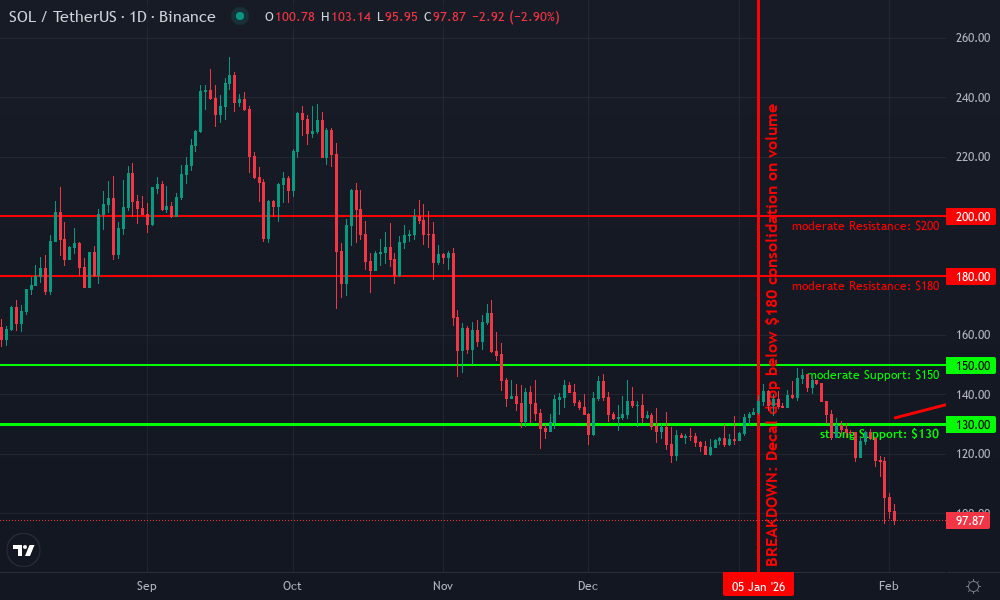
Solana Technical Analysis Chart
Analysis by Market Analyst | Symbol: BINANCE:SOLUSDT | Interval: 1D | Drawings: 8
Technical Analysis Summary
To annotate this SOLUSDT chart in my balanced technical style, start by drawing a prominent downtrend line connecting the November 2026 high around $255 to the recent February 2026 lows near $132, highlighting the dominant bearish channel. Add an earlier uptrend line from October 2026 lows at $140 to the same $255 peak for context on the prior rally. Mark horizontal lines at key support $130 (strong) and resistance levels $180 (moderate), $200 (moderate), and $230 (weak). Use rectangles to outline the December 2026 consolidation zone between $180-$210. Place callouts on volume spikes during downside moves to note bearish confirmation, and arrow_mark_down on the MACD for the recent bearish crossover. Fib retracement from peak to recent low for potential bounce levels. Add text notes for entry zone near $135 with medium risk, profit target $180, stop $125. Vertical line at early January 2026 breakdown below $180. This setup visualizes the topping pattern, distribution phase, and potential reversal setup balanced with current ecosystem tailwinds.
Risk Assessment: medium
Analysis: Chart shows clear downtrend with support test, but Solana's 2026 local fee markets and appchain news provide bullish asymmetry; medium tolerance suits waiting for reversal signals
Market Analyst's Recommendation: Hold cash or tight stops on longs near $135; avoid new shorts, target $180 if $150 breaks
Key Support & Resistance Levels
📈 Support Levels:
- $130 - Recent Feb 2026 lows with volume cluster, strong demand zone strong
- $150 - Mid-Dec bounce level, prior consolidation low moderate
📉 Resistance Levels:
- $180 - Broken Dec support turned resistance, Jan breakdown key moderate
- $200 - Dec consolidation high, multiple tests moderate
- $230 - Minor peak before final drop weak
Trading Zones (medium risk tolerance)
🎯 Entry Zones:
- $135 - Oversold bounce from strong support $130, aligned with Solana fee market positives medium risk
🚪 Exit Zones:
- $180 - First resistance retest for profit take 💰 profit target
- $125 - Below strong support invalidates long setup 🛡️ stop loss
Technical Indicators Analysis
📊 Volume Analysis:
Pattern: Bearish divergence - spikes on downside, dries up on upside attempts
Confirms distribution phase post-rally, watch for reversal spike
📈 MACD Analysis:
Signal: Bearish crossover in Dec 2026, histogram contracting negative
Momentum fading but oversold divergence emerging
Applied TradingView Drawing Utilities
This chart analysis utilizes the following professional drawing tools:
Disclaimer: This technical analysis by Market Analyst is for educational purposes only and should not be considered as financial advice. Trading involves risk, and you should always do your own research before making investment decisions. Past performance does not guarantee future results. The analysis reflects the author's personal methodology and risk tolerance (medium).
Why App-Chains Thrive with Dynamic Local Fees
Custom app-chains aren't generic L2s; they're tailored beasts for DeFi, gaming, or AI agents. But without custom app-chains fee structures, demand spikes in one module cascade everywhere. Dynamic locals fix that. Picture ephemeral rollups: spin up temporary chains for peaks, decommission post-rush. Fees stay predictable, inclusion reliable.
Syndicate's smart sequencers nail customization. Upgrade modules via smart contracts for bespoke ordering rules, MEV resistance, and tokenomics. Their SYND token? Holding steady at $0.0575, with 24-hour trades between $0.0563 and $0.0580 signaling market confidence in app-chain infra. No economic value loss from centralized sequencers here.
Challenges? Fee estimation isn't perfect yet. Peak-time inclusion can falter without refined QoS. But ongoing tweaks, like Solana's validator tools, point to smoother sails. For rollup builders, this means app-chain congestion prevention without sacrificing sovereignty.
Blueprints for Rollup Builders: From Vision to Velocity
Ready to build? Start with isolated markets per program. Define contention zones: accounts, storage slots, compute budgets. Implement auctions within locals, blending base and priority fees. Integrate stake-weighted QoS for fairness. Tools from Helius or QuickNode's RaaS accelerate this, letting you launch sovereign L1 app-chains or L2/L3 rollups primed for scale.
Dive deeper into developer guides for code patterns. Or explore real-world examples powering high-throughput dApps. The "everyone gets a chain" era demands specialized blockchain fees; ignore locals at your peril.
Picture this: your gaming app-chain hits a raid boss event, transactions flood in for loot contracts, but social features and leaderboards keep chugging at pennies. That's the magic of dynamic local fee markets in action, isolating spikes like a pro surfer dodging rogue waves.
Ephemeral rollups take it further, auto-spinning mini-chains for those frenzy moments. High demand? Boom, a temporary rollup absorbs the load, fees localized, main chain untouched. Post-peak, it dissolves, data settled back seamlessly. This elastic setup crushes rigid scaling, perfect for unpredictable dApps like AI-driven trading bots or viral socialFi plays.
Global vs. Local Fee Markets Comparison
| Feature | Global Fee Markets (Ethereum 🟣) | Local Fee Markets (Solana 🟢) |
|---|---|---|
| Fee Granularity | Uniform network-wide fee 🏛️📈 | Per-account/program-specific based on contention 🎯🔍 |
| Congestion Isolation | Affects entire network 🌐❌ | Isolated to high-demand state areas 🔒✅ |
| UX During Peaks | Degraded for all users, high fees & delays 😞📉 | Smooth for unaffected txs, granular prioritization 🚀😊 |
| Examples | Ethereum (global base fee via EIP-1559) 📊 | Solana (LFMs with base/priority fees & QoS) 🔗 |
Taming Peaks: Ephemeral Rollups and QoS Mastery
Stake-weighted QoS isn't fluff; it's your bouncer at the door. Bigger stakers get packet priority, smoothing inclusion without fee wars. Pair it with precise compute unit metering, and you've got rollup fee optimization that feels native. Builders using Zeeve's platform launch these sovereign app-chains fast, L1 to L3, all with baked-in local markets. QuickNode's RaaS echoes this, optimizing for use-case efficiency.
Yet, pitfalls lurk. Misestimated fees lead to failed txs, eroding trust. Solution? Client-side simulators, like Solana's, preview costs pre-submit. Validators expose APIs for real-time contention data, empowering wallets to guide users. We're seeing this evolve in Syndicate's smart sequencers, where upgrades tweak ordering sans hard forks. SYND's steady at $0.0575, dipping no lower than $0.0563 recently, underscoring bets on customizable infra.
Granular control extends to MEV defense. Local markets let you auction tips per program, curbing sandwich attacks without global penalties. Tokenomics shine too: app-specific tokens fund priority boosts, aligning incentives. No more sequencer centralization bleeding value; app-chains reclaim economics.
Overcoming Hurdles: Fee Prediction and Reliability
Reliable inclusion during chaos? Dynamic locals demand smart tooling. Helius unpacks Solana's validator dance: compute fees on-the-fly, reject spam early. Port this to your chain via modular sequencers. Challenges like state contention forecasting improve with ML oracles, eyeing AI agents for proactive scaling.

Transactions pay based on their level of contention, ensuring spikes don't blanket the network.
Table that up:
- Prediction accuracy: Simulate tx bundles for 95% hit rates.
- QoS fairness: Delegate weights prevent whale dominance.
- Elasticity: Ephemeral chains for 10x bursts.
For rollup builders, integrate via specialized fee market guides. Platforms like Syndicate make it plug-and-play, fostering that "everyone gets a chain" vibe.
Dynamic locals aren't a nice-to-have; they're the congestion shield every custom app-chain needs. Ride this wave: granular pricing, ephemeral elasticity, QoS muscle. Your dApp stays fast, fees fair, users hooked. Builders, spec it now, scale tomorrow. Momentum's building, don't fight the tide.



No comments yet. Be the first to share your thoughts!