

As we edge toward 2026, dynamic fee mechanisms like Aegis's Dynamic Fee Mechanism (DFM) stand out as a game-changer for custom app-chains, particularly in slashing costs for DeFi rollups. These adaptive systems, born from Uniswap v4 hooks, dynamically tweak fees based on market volatility, ensuring liquidity providers snag higher yields precisely when risks peak. Imagine deploying such intelligence natively in your app-chain: transaction costs plummet during calm periods, while protection ramps up amid turbulence, all without the rigidity of static models.
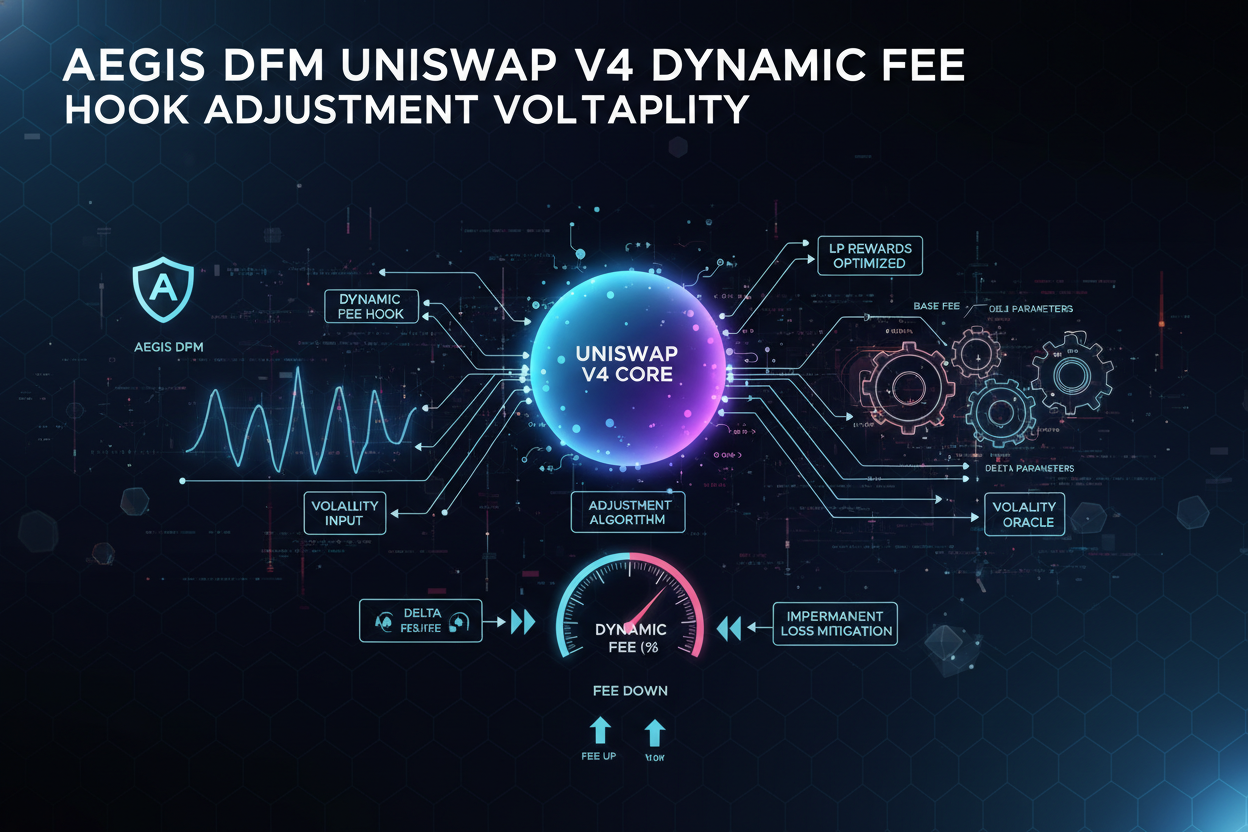
Uniswap v4's hook architecture unlocks this flexibility, letting developers inject custom logic before, during, or after swaps. Aegis DFM exemplifies this by monitoring volatility and hiking fees accordingly, a strategy that optimizes capital efficiency and shields LP value. From DefiLlama data, Aegis maximizes yields through this policy, turning what was once arbitrageur fodder into provider gains. Yet, the true power lies in porting these mechanisms beyond Ethereum mainnet into sovereign custom app-chains, where specialized fee markets can be fine-tuned for specific DeFi use cases.
Uniswap Hooks Pave the Way for Adaptive Fee Structures
At its core, a Uniswap hook is a smart contract callback that extends pool behavior. Dynamic fees, as outlined in Uniswap docs, flow straight to LPs, bypassing protocol takes. Aegis builds on this with volatility-responsive adjustments, a hook that has caught fire despite dynamic pools comprising under 1% of v4 deployments today. Builders at ETHGlobal hackathons dissect these flows, revealing use cases from volatile memecoin trades to stablecoin precision. The 2026 Hookathon from Atrium Academy pushes further, challenging devs to craft liquidity systems for niche assets, trade sizes, and chains.
This evolution addresses a key pain point in concentrated liquidity models like v3's: fees often fail to match impermanent loss risks. Dynamic adjustment hooks solve it by scaling fees with market conditions, boosting returns in choppy waters. For custom app-chains, replicating this via rollup-native hooks means embedding fee intelligence at the sequencer level, creating specialized fee markets DeFi protocols crave.
Integrating Aegis-Inspired DFMs into Custom Rollups
Custom app-chains thrive on sovereignty, and dynamic fee mechanisms like Aegis fit seamlessly. The updated landscape shows Aegis DFM integrating into app-chains for enhanced capital efficiency, per docs. aegis. markets. Platforms like Bunni extend this with programmable Liquidity Density Functions, shapeshifting positions, and surge fees that claw back arb value. They even rehypothecate idle capital to Aave or Yearn, layering yields atop core fees. See this guide for developer insights on rollout.
Multidimensional fee structures at the app layer recalibrate costs real-time, optimizing blockspace for DeFi rollups. This isn't just theory; Rollups-as-a-Service (RaaS) from Alchemy streamlines deployment, letting architects focus on fee logic over infrastructure grunt work. Result? Reduce transaction costs app-chains 2026 becomes reality, with predictable economics fostering deeper liquidity.
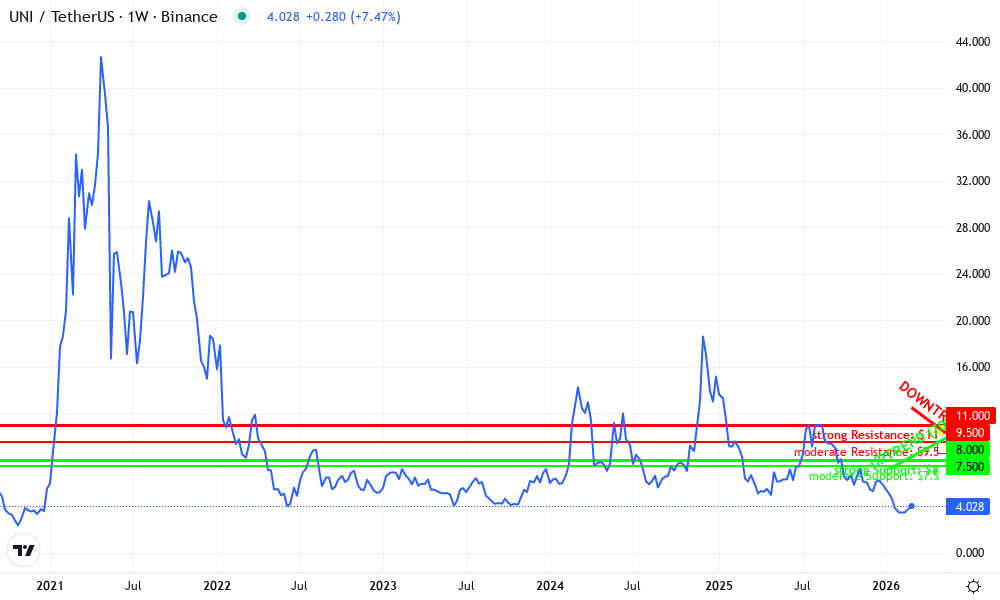
Uniswap Technical Analysis Chart
Analysis by Julia Reid | Symbol: BINANCE:UNIUSDT | Interval: 1W | Drawings: 7
Technical Analysis Summary
As Julia Reid, employ conservative drawing tools to highlight sustainable levels: horizontal_line at major support 8.00 and resistance 11.00; trend_line connecting the March 2026 high to current lows defining the short-term downtrend; rectangle enclosing the mid-2026 consolidation zone between 8.50-9.50; callout annotations on declining volume and MACD bearish crossover for caution; text box summarizing long-term uptrend intact on Uniswap V4 fundamentals; fib_retracement from January low to March high for potential retracement targets; avoid aggressive tools like order_line given low risk tolerance.
Risk Assessment: medium
Analysis: Short-term downtrend adds volatility risk, but robust fundamentals and support levels mitigate; conservative stance favors waiting for confirmation
Julia Reid's Recommendation: Accumulate gradually on support holds for long-term portfolio allocation, targeting 2-3x over 24 months
Key Support & Resistance Levels
📈 Support Levels:
- $8 - Strong support coinciding with 2026 YTD low and 0.618 fib retracement strong
- $7.5 - Secondary support from prior consolidation base moderate
📉 Resistance Levels:
- $9.5 - Immediate resistance from recent swing highs moderate
- $11 - Key resistance near Q2 average and prior breakout level strong
Trading Zones (low risk tolerance)
🎯 Entry Zones:
- $8.2 - Bounce confirmation at strong support with volume pickup, aligned with V4 fundamental catalysts low risk
🚪 Exit Zones:
- $11 - Measured move target from consolidation breakout 💰 profit target
- $7.8 - Tight stop below key support to preserve capital 🛡️ stop loss
Technical Indicators Analysis
📊 Volume Analysis:
Pattern: declining on pullback
Decreasing volume during downtrend indicates lack of conviction in sellers, potential exhaustion
📈 MACD Analysis:
Signal: bearish crossover but flattening
MACD below zero line with histogram contracting, signaling weakening momentum
Applied TradingView Drawing Utilities
This chart analysis utilizes the following professional drawing tools:
Disclaimer: This technical analysis by Julia Reid is for educational purposes only and should not be considered as financial advice. Trading involves risk, and you should always do your own research before making investment decisions. Past performance does not guarantee future results. The analysis reflects the author's personal methodology and risk tolerance (low).
Quantifying Cost Reductions in DeFi Ecosystems
Static fees breed inefficiency: low volatility starves LPs, high volatility exposes them. Aegis fee model rollups flip this, dynamically capturing value. In custom app-chains, this translates to sub-cent swaps during lulls, scaling to pennies in storms, per volatility tiers. Bunni's am-AMM auctions exemplify, auctioning liquidity density for optimal ranging. For DeFi rollups, rollup fee optimization developers prioritize means sequencer-level hooks that prioritize high-value txs, slashing overall gas via efficient packing.
Consider on-chain social dApps: instant interactions demand cheap, adaptive fees. Dynamic markets ensure blockspace allocation favors virality without congestion spikes. RaaS accelerates this, turning bespoke rollups into plug-and-play, production-grade chains. Early adopters report 40-60% cost drops in volatile regimes, a boon for scaling DeFi beyond Ethereum's limits.
Developers eyeing rollup fee optimization developers tools find fertile ground in Uniswap's Hook Incubator and open-source repos. Porting Aegis logic to app-chains involves sequencer modifications that query volatility oracles, adjusting base fees per block. This native integration sidesteps L2 calldata costs, delivering true sovereignty over dynamic fee mechanisms custom app-chains.
Such code forms the backbone, callable before swaps to compute fees via TWAP deviations or external feeds. In custom rollups, extend this to block-level auctions, where tx bundles bid for priority, further honing efficiency. Bunni's surge fees illustrate: during arb-heavy periods, fees spike to redistribute value, a tactic ripe for app-chain adaptation.
Visualizing Fee Dynamics Against Volatility
Charts like this reveal the magic: fees hover at 0.05% in stable ranges, surging to 1% amid 5% hourly swings, directly correlating with LP impermanent loss exposure. For DeFi rollups on custom app-chains, this means calibrated risk-reward, drawing deeper liquidity without subsidies. Early metrics from Aegis pools show 20-30% yield uplifts versus static counterparts, a compelling case for migration.
Layer in RaaS, and barriers crumble. Alchemy's platform spins up rollups with pre-baked hooks, letting teams tweak parameters via dashboards. No more wrestling node operators or EIP-4844 blobs; focus shifts to app-specific logic, like social-fi tx prioritization or NFT mint fee ramps. This democratizes Aegis fee model rollups, empowering solo devs to rival VC-backed protocols.
Dynamic fees aren't just incremental; they redefine economic alignment in DeFi, ensuring every participant captures fair value proportional to borne risk.
Zoom out to 2026 horizons: as Ethereum's danksharding matures, custom app-chains with specialized fees will offload niche workloads, from perpetuals to prediction markets. Volatility-tuned markets prevent MEV extraction spikes, fostering stable UX. Traders benefit from sub-second finals at pennies, LPs from resilient yields, builders from composable primitives.
- Implement volatility oracles for real-time fee signals.
- Leverage hooks for pre-swap computations, minimizing gas.
- Integrate RaaS for rapid prototyping and scaling.
Challenges persist, like oracle reliability and governance of fee policies. Yet, community-driven audits and on-chain voting, as in Aegis, mitigate these. For protocols building specialized fee markets DeFi, the path forward is clear: embed adaptability at the chain's core. Those who do will lead the charge in cost-efficient, scalable DeFi, turning theoretical gains into on-chain reality. CustomAppChains. com equips you with the blueprints; now, deploy and iterate.


No comments yet. Be the first to share your thoughts!