The 2026 shift to dedicated infrastructure
Enterprise blockchain adoption in 2026 is defined by a decisive structural break from shared Layer 2 networks. Organizations are migrating to dedicated app chains to secure full sovereignty over infrastructure, ensuring that operational performance and regulatory compliance remain isolated from public network volatility. This shift addresses the primary institutional requirement: dedicated capacity that guarantees predictable execution without reliance on congested shared sequencers.
The risk of operating on shared infrastructure has moved beyond technical inconvenience to material compliance exposure. When an enterprise application competes for block space with unrelated public transactions, latency spikes and failed transactions become inevitable. For regulated entities, these failures are not merely operational errors but potential breaches of service level agreements and data integrity mandates. Dedicated chains eliminate this contention, providing a controlled environment where throughput is reserved solely for business-critical workflows.
This architectural choice also isolates cost structures. Public networks introduce variable gas fees that complicate financial forecasting and audit trails. By deploying a dedicated chain, enterprises convert variable operational expenditures into fixed infrastructure costs, enabling precise budgeting and consistent performance metrics. This stability is essential for integrating blockchain processes with traditional enterprise resource planning systems that demand deterministic timing.
The underlying economic reality of blockchain infrastructure supports this migration. As the cost of maintaining secure, high-throughput networks fluctuates, enterprises require predictability that only sovereign chains can provide. The volatility of Layer 1 and Layer 2 fees directly impacts the total cost of ownership for digital assets and tokenized services.
The decision to adopt dedicated app chains is driven by the need for operational certainty. Shared networks offer scalability in theory but often fail in practice when institutional workloads peak. Dedicated infrastructure ensures that an enterprise’s application remains available and compliant, regardless of broader market activity. This isolation is no longer a luxury but a prerequisite for serious enterprise deployment.
Cosmos SDK, Substrate, and Avalanche Compared
Selecting an enterprise-grade framework requires evaluating structural tradeoffs between interoperability, development flexibility, and consensus finality. For legal and operational teams, the choice dictates how data sovereignty, cross-border compliance, and network governance are enforced. The following comparison isolates the core architectural differences that impact enterprise scalability and regulatory adherence.
| Framework | Language Stack | Governance Model | Interoperability | Consensus Mechanism |
|---|---|---|---|---|
| Cosmos SDK | Go, Rust | On-chain voting & upgrades | IBC (native cross-chain) | Tendermint BFT |
| Substrate | Rust | Customizable pallets & referenda | XCMP (Polkadot) | Nominated Proof-of-Stake (NPoS) |
| Avalanche Subnets | Go (C-Chain) | Platform-level & subnet config | VM-based cross-subnet | Avalanche Consensus (AC) |
Cosmos SDK prioritizes interoperability through the Inter-Blockchain Communication (IBC) protocol. This architecture allows enterprises to deploy sovereign chains that can securely transfer assets and data across the Cosmos ecosystem. For organizations requiring complex cross-border data flows, IBC provides a standardized, auditable channel for compliance. However, the reliance on a specific ecosystem limits flexibility if the enterprise operates outside the Cosmos "internet of blockchains."
Substrate offers maximum flexibility by allowing developers to construct custom consensus engines and runtime logic in Rust. This modularity is advantageous for legal entities requiring highly specific governance structures or unique data privacy controls. The tradeoff is a steeper learning curve and the potential for fragmentation if the custom chain does not align with Polkadot’s relay chain security model.
Avalanche Subnets provide high-throughput finality through its Avalanche Consensus protocol. This is particularly relevant for enterprise applications requiring near-instant transaction settlement, such as high-frequency trading or real-time supply chain tracking. Subnets are isolated yet share the security of the primary Avalanche network, offering a balanced approach between customization and established security guarantees.
The decision ultimately rests on whether the enterprise prioritizes cross-chain liquidity (Cosmos), custom governance logic (Substrate), or transaction speed (Avalanche). Each framework presents distinct risks regarding upgrade complexity and long-term maintenance, which must be weighed against operational requirements.
Compliance and Data Sovereignty
Shared public chains present an unacceptable liability for enterprise deployments. Because transaction data is replicated across all nodes, sensitive information becomes permanently visible to competitors, auditors, and potentially malicious actors. For organizations bound by GDPR, HIPAA, or strict data residency laws, this transparency is not a feature—it is a violation.
Dedicated app chains solve this by providing isolated infrastructure. You retain full control over data visibility, ensuring that sensitive records never leave your designated jurisdiction or network. This isolation is critical for meeting legal obligations regarding data minimization and purpose limitation, which public chains cannot guarantee.
The risk of non-compliance on shared infrastructure is high. A single exposure of protected health information (PHI) or personal data can result in severe regulatory fines and operational shutdowns. Private app chains eliminate this exposure by design, allowing enterprises to build compliant workflows without relying on external governance or third-party validators.
Adoption trends in 2026 show a clear shift toward sovereign infrastructure for regulated industries. Institutions are moving away from multi-tenant solutions that offer limited control. Instead, they are building dedicated chains that align with their specific legal and operational requirements. This structural shift ensures that compliance is baked into the architecture, not bolted on afterward.
Building and operating the chain
Enterprise app chains require a shift from traditional DevOps to ChainOps, where infrastructure management is inextricably linked to consensus and state validation. Running a custom chain is not merely a deployment task; it is an ongoing operational commitment that carries significant regulatory and security liabilities. Organizations must treat node management, validator selection, and data archival as core compliance functions rather than backend utilities.
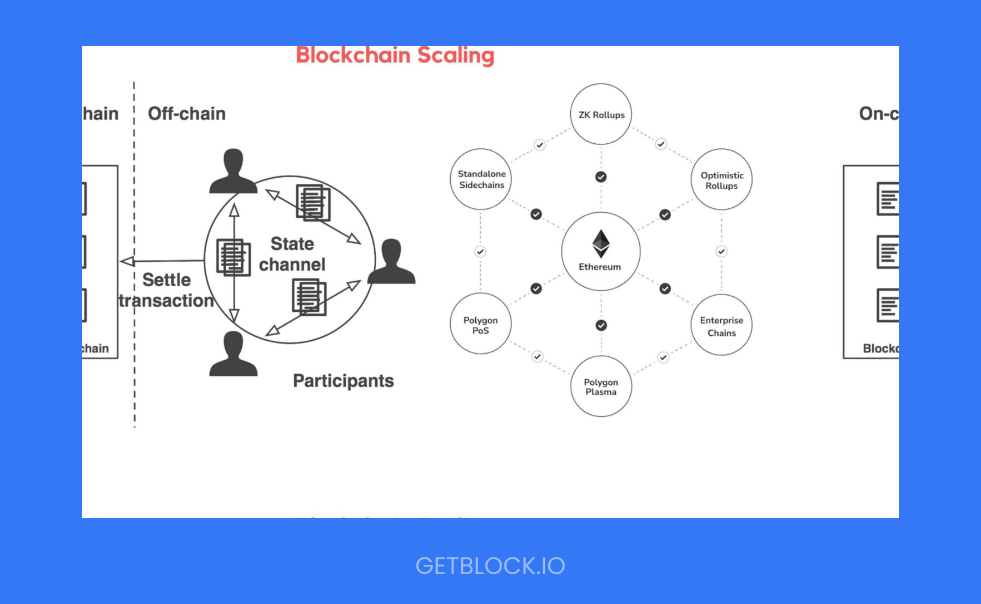
Validator selection dictates chain security and decentralization. Enterprise operators must ensure validator diversity to prevent single points of failure and potential regulatory scrutiny regarding centralized control. Nodes must be hosted in jurisdictions with clear data sovereignty laws, and operators must maintain strict access controls to prevent unauthorized state modifications. Failure to diversify validators can expose the chain to censorship or consensus attacks.
Node infrastructure must be designed for high availability and data integrity. Operators should utilize dedicated hardware or private cloud instances to ensure consistent performance and isolate the chain from public network volatility. Regular security audits of the node software are mandatory to patch vulnerabilities before they can be exploited. This infrastructure forms the backbone of the app chain, directly impacting transaction throughput and finality.
Data archival is a critical compliance requirement, particularly for industries subject to record-keeping regulations like finance or healthcare. Full archival nodes must be maintained to ensure complete historical state access for audits and legal discovery. Operators must implement automated backup strategies and immutable storage solutions to prevent data loss. Non-compliance with data retention standards can result in severe legal penalties and operational shutdowns.
The operational reality of an app chain demands continuous monitoring and proactive risk management. Unlike public networks, where security is shared, enterprise app chains place the burden of security entirely on the operator. This requires a dedicated team familiar with both blockchain consensus mechanisms and enterprise IT governance. The transition to ChainOps is not optional; it is a prerequisite for sustainable and compliant operation.
-
Security audit of validator nodes
-
Validator diversity assessment
-
Data archival strategy implementation
Cost structure and total cost of ownership
Building a custom app chain introduces a distinct financial architecture compared to managed SaaS blockchain solutions. The primary distinction lies in the shift from operational expenditure (OpEx) to significant upfront capital expenditure (CapEx). While SaaS models offer predictable monthly subscriptions, custom chains require dedicated infrastructure, node maintenance, and specialized development resources that are not amortized over time.
Infrastructure and Development Overhead
The initial build phase demands substantial engineering investment. Unlike SaaS platforms where the underlying ledger is abstracted, custom chains require the configuration of consensus mechanisms, validator nodes, and state-sync protocols. This complexity drives up the cost of the initial build, which typically ranges from $50,000 to $250,000 depending on the chain's complexity and security requirements. Ongoing infrastructure costs include dedicated server hosting, database management, and network security audits, which are variable and scale with transaction volume.
Long-Term Maintenance and Compliance
Maintenance costs for custom chains are often underestimated. They include routine software updates, patching vulnerabilities, and managing validator rewards. In a legal and regulatory context, the cost of non-compliance—such as failing to implement proper KYC/AML layers or data privacy controls—can far exceed the initial development costs. Organizations must budget for continuous legal review and technical audits to ensure the chain remains compliant with evolving regulations. This long-tail operational burden contrasts sharply with SaaS solutions, where the provider absorbs most maintenance and compliance updates.
Comparative Cost Analysis
The following table outlines the structural differences in cost allocation between custom app chains and SaaS blockchain services. This comparison highlights the trade-offs between control and predictability.
| Category | Custom App Chain | SaaS Blockchain |
|---|---|---|
| Initial Build | High ($50k–$250k+) | Low/None |
| Monthly Infrastructure | Variable (Dedicated Nodes) | Fixed Subscription |
| Maintenance | In-house or Contracted | Provider Managed |
| Compliance Updates | Internal Responsibility | Provider Responsibility |
Operational Cost Context
The financial implications of blockchain infrastructure are also influenced by underlying token economics and network fees. For chains utilizing native tokens for gas or staking, market volatility directly impacts operational budgets. The following widget provides real-time context for major infrastructure-related assets, illustrating how market fluctuations can affect long-term cost projections.
Frequently asked questions about app chains
What is the realistic timeline for deploying a compliant enterprise app chain?
Development timelines typically range from three to nine months for a production-ready chain. This includes framework selection, consensus configuration, and rigorous security testing. Managed solutions can accelerate deployment to weeks, but customization limits may hinder specific enterprise needs. Proper planning and clear requirement definitions are essential to avoid scope creep and ensure timely delivery.
How do app chains address data residency and privacy regulations?
App chains can achieve regulatory compliance, but it requires deliberate architectural design. Unlike public blockchains, private app chains allow enterprises to implement Know Your Customer (KYC) and Anti-Money Laundering (AML) controls at the protocol level. However, data residency laws and cross-border transaction rules still apply. Legal teams must review the chain's governance model to ensure it meets jurisdictional requirements.
What are the primary cost drivers for custom app chain infrastructure?
Costs vary significantly based on infrastructure choices. Using managed services like Chainstack reduces initial capital expenditure but introduces recurring operational fees. Building from scratch with frameworks like Cosmos SDK or Substrate requires substantial engineering investment but offers long-term sovereignty. Enterprises should budget for node maintenance, security audits, and compliance overhead, which often exceed initial development costs.
No comments yet. Be the first to share your thoughts!