

In the relentless pursuit of blockchain scalability, general-purpose networks like Ethereum expose a glaring vulnerability: cross-demand congestion. When DeFi protocols, NFT drops, and gaming dApps vie for the same block space, fees spike unpredictably, throttling user experience and developer confidence. Custom app-chains counter this chaos with isolated fee markets, carving out sovereign economic zones where each rollup dictates its own pricing dynamics. This precision engineering not only prevents demand spillover but redefines scalability for specialized use cases, from high-frequency trading to immersive virtual worlds.
Consider Solana's exploration of ephemeral rollups, which spin up temporary chains to absorb peak loads before dissolving. Such innovations underscore a broader shift: app-chains aren't just alternatives; they're the analytical imperative for sustainable growth. By segregating fee mechanisms, developers sidestep the pitfalls of monolithic ledgers, where one application's surge cascades into widespread inefficiency.
Decoding Cross-Demand Congestion in Shared Environments
Shared fee markets operate like a single auction house crowded with disparate bidders. In Ethereum's ecosystem, for instance, a viral memecoin launch can inflate gas prices tenfold, sidelining low-value transactions from other dApps. Data from recent analyses, including those on modular blockchains, reveal how this competition for limited resources breeds volatility. Rollups on shared layers inherit these flaws, as even optimistic or ZK variants contend with base-layer bottlenecks during peaks.
The mechanics are straightforward yet punishing. EIP-1559 introduced base fees that adjust dynamically, but in multi-tenant settings, external demand distorts the signal. A DeFi liquidation cascade might prioritize compute-heavy calls, starving bandwidth for simpler transfers. Sovereign app-chains disrupt this cycle by deploying dedicated sequencers and validators, each tuned to application-specific throughput needs.
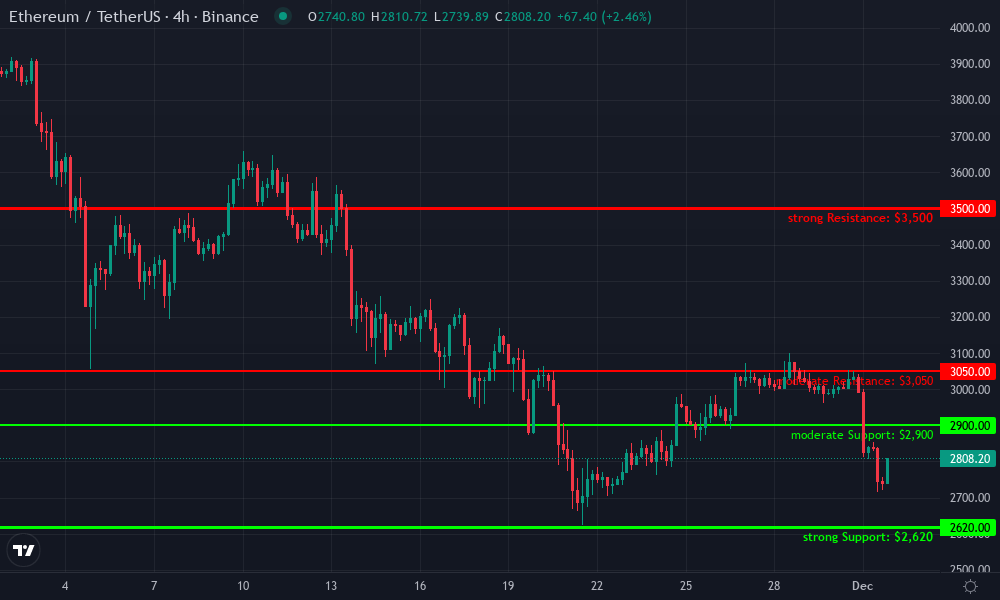
Ethereum Technical Analysis Chart
Analysis by Evan Bristow | Symbol: BINANCE:ETHUSDT | Interval: 4h | Drawings: 7
Technical Analysis Summary
To annotate this ETHUSDT chart in my precise, data-driven style: Start with a prominent 'trend_line' connecting the swing high on 2025-12-10 at ~3850 to the recent swing high on 2025-12-22 at ~3050, extending forward to project the downtrend channel lower boundary around 2600-2650. Add 'horizontal_line' supports at 2620 (strong multi-touch low) and 2900 (prior consolidation base), resistances at 3050 and 3500. Overlay 'fib_retracement' from the Dec 10 high (3850) to Dec 28 low (2620) to highlight 38.2% retrace (~3050) and 50% (~3235) as potential reversal zones. Use 'rectangle' for the late-Dec consolidation/distribution range (2025-12-22 to 2025-12-28, 2720-3050). Mark volume spikes with 'callout' arrows pointing to downside climaxes. Add 'text' labels for key levels with strength ratings. Finally, 'long_position' entry zone at 2620-2650 with stop below 2600 and target 3050, emphasizing risk-managed swing setups amid bearish momentum.
Risk Assessment: medium
Analysis: Bearish trend intact with volatility from recent dumps, but support confluence and macro tailwinds (app-chain scalability) limit downside; medium tolerance suits defined risk setups
Evan Bristow's Recommendation: Monitor 2620 hold for low-conviction longs with 1:2 RR—precision over prediction, clarity in tight stops
Key Support & Resistance Levels
📈 Support Levels:
- $2,620 - Strong multi-candle test with volume shelf, key psychological hold strong
- $2,900 - Prior swing low and consolidation base, moderate confluence moderate
📉 Resistance Levels:
- $3,050 - Recent swing high and fib 38.2%, overhead supply zone moderate
- $3,500 - Major prior high from early Dec rally, strong barrier strong
Trading Zones (medium risk tolerance)
🎯 Entry Zones:
- $2,650 - Bounce from strong support amid oversold conditions and positive scalability context, aligns with swing hybrid setup medium risk
- $2,900 - Breakout above minor resistance for confirmation long, lower risk on momentum shift low risk
🚪 Exit Zones:
- $3,050 - Initial profit target at resistance/fib level, secure gains on retrace 💰 profit target
- $3,500 - Extended target on channel break, trail stops 💰 profit target
- $2,600 - Tight stop below support invalidation 🛡️ stop loss
Technical Indicators Analysis
📊 Volume Analysis:
Pattern: Increasing volume on downside breaks, drying up on rebounds—bearish distribution signal
Climax volume on Dec 25-28 drop confirms selling pressure, watch for reversal on low volume test of lows
📈 MACD Analysis:
Signal: Bearish crossover below zero line with histogram expansion
Momentum divergence potential as price tests lows; crossover mid-Dec sealed downtrend
Applied TradingView Drawing Utilities
This chart analysis utilizes the following professional drawing tools:
Disclaimer: This technical analysis by Evan Bristow is for educational purposes only and should not be considered as financial advice. Trading involves risk, and you should always do your own research before making investment decisions. Past performance does not guarantee future results. The analysis reflects the author's personal methodology and risk tolerance (medium).
Precision Engineering of Isolated Fee Markets
At their core, isolated fee markets in app-chains function as autonomous EIP-1559 variants, or bespoke alternatives like maker-taker models. Each chain sets its base fee, priority tips, and resource weights independently, reflecting true marginal costs. For a gaming rollup, this might mean subsidizing low-latency state updates while charging premiums for asset mints; a payments chain could flatten fees for micro-transactions altogether.
This isolation extends to data availability layers. With dedicated posting to Celestia or EigenDA, app-chains avoid Ethereum's blob constraints, implementing parallel auctions for calldata. Empirical evidence from SKALE networks demonstrates zero-gas environments for dApps, where custom structures eliminate user friction entirely. The result? Predictable economics that attract liquidity without the drag of externalities.
"Rollup solutions offer dramatic fee reductions, while sovereign chains can customize fee structures for specific use cases. " – Insights from multichain benchmarking.
Strategic Benefits Driving Adoption
Quantitatively, isolated markets excel in resource allocation. Networks like SKALE report instant finality and tailored TPS, unhindered by broader ecosystem noise. Prevention of cross-demand congestion translates to 5-10x fee stability during peaks, per scalability guides. Developers gain granular control: dynamic adjustments via oracles for real-time demand, or resource-specific pricing that bills compute separately from storage.

Optimization shines in verticals. Gaming app-chains prioritize sub-second confirmations, evading the latency tax of shared sequencer queues. DeFi variants enforce MEV-resistant auctions natively, curbing exploiter dominance. Even ephemeral setups on Solana promise elastic scaling, ramping capacity to millions of TPS before idling, all without fee volatility bleed.
Yet, implementation demands rigor. Pricing attacks, as detailed in recent arXiv papers, highlight vulnerabilities in naive TFMs. Robust designs incorporate oversupply buffers and isolated EIP-1559 for DA layers, ensuring resilience. For deeper dives into these mechanisms, explore custom fee market design strategies.
App-chains demand vigilant fee governance to thwart sophisticated exploits. Recent research exposes how mispriced transaction fee mechanisms in rollups invite denial-of-service attacks or profit extraction via manipulated bids. Isolated setups mitigate this by ring-fencing auctions, enforcing minimum viable tips calibrated to chain-native demand signals. Pairing these with oracle-fed dynamic caps prevents oversaturation, a tactic proven in modular DA layers where parallel EIP-1559 instances buffer excess calldata supply.
Comparative Fee Performance: Shared vs Isolated Markets
Empirical benchmarks illuminate the edge of isolated fee markets in app-chains. Traditional rollups tethered to Ethereum's base layer endure fee volatility exceeding 500% during congestion, per multichain development reports. Sovereign chains, conversely, sustain sub-10% variance, channeling resources precisely to dApp priorities. This stability cascades into superior UX: gamers enjoy uninterrupted sessions, while DeFi traders execute at forecasted costs.
Shared L2 Rollups vs. Isolated App-Chains: Performance Comparison
| Metric | Shared L2 Rollups | Isolated App-Chains |
|---|---|---|
| Fee Volatility | 🔴 High (unpredictable spikes from cross-demand congestion) | 🟢 Stable (isolated fee markets prevent spillover) |
| TPS During Peaks | 🔴 100-1,000 TPS (limited by shared resources) | 🟢 10,000+ TPS (dedicated app-chain capacity, e.g., Solana ephemeral rollups) |
| Congestion Resistance | 🔴 Low (affected by other dApps) | 🟢 High (custom fee structures and resource isolation) |
ZK rollups amplify these gains when sovereign, sidestepping shared prover queues that inflate latency. Platforms benchmarking across L1s, rollups, and app-chains consistently rank the latter highest for predictable economics, especially in high-TPS scenarios like payments or NFTs.
Navigating Implementation Hurdles
Transitioning to custom rollups with specialized fees isn't seamless. Developers must orchestrate sequencer decentralization to avert centralization risks, often via threshold signatures or distributed proposers. Integration with modular stacks, Celestia for DA, EigenLayer for restaking, adds layers of coordination, yet yields compounded scalability. Opinion: while ephemeral models on Solana tantalize with elasticity, persistent app-chains offer the maturity for production-grade DeFi and gaming.
In shared chains, congestion spikes fees and erodes UX; app-chains with isolated markets sidestep this entirely.
Layer 3 experiments further validate the thesis, nesting isolated markets atop rollups for hyper-specialized verticals. Yet, the real litmus test lies in economic incentives: maker-taker rebates draw liquidity magnets, fortifying nascent chains against bootstrap fragility. For tactical blueprints, consult guides on implementing specialized fee markets.
Future Horizons for Scalable App-Chains
Looking ahead, isolated fee markets will anchor the app-chain era, propelled by Ethereum's modular pivot and Solana's throughput feats. Expect hybrid ephemeral-persistent hybrids, auto-scaling via AI-oracles that preempt demand surges. Pricing resilience against attacks will standardize, with formal verification of TFMs becoming table stakes. Developers eyeing scalable app-chains with fee isolation should prioritize sovereign stacks: they don't just scale transactions; they scale trust in economic sovereignty.
This architectural pivot empowers builders to craft app-specific blockchain fee structures that mirror real-world utility, unshackled from generalist drag. As demand for custom rollups surges, those mastering isolated markets will lead the charge in frictionless, high-fidelity decentralized applications.




No comments yet. Be the first to share your thoughts!